Learning together: how others can fuel (or hinder) our curiosity

A story of “motivating” cakes
A few days ago, our team gathered around a table for a collective writing session — a “blogathon,” as we called it Click here to see other posts from the team. Each of us had to write a post on a research topic related to the team’s focus. The goal was to learn or practice writing scientific content in this format. Between bites of the small cakes brought by a colleague, I started typing my first lines… a situation that perfectly illustrated, in real conditions, the very topic I wanted to address.
Why am I writing this article? To learn how to write a blog post? To share my research? To deepen my own understanding of the literature? To be part of a team dynamic initiated by our director? Because my colleagues were there too, writing, creating a focused and supportive working atmosphere around me?
The honest answer: probably all of the above. And it is precisely this overlap of motivations—reflecting many everyday activities—that leads us to a fundamental question in cognitive and educational sciences: to what extent do others—their mere presence, their gaze, their activity—influence our motivation to learn?
Intrinsic and extrinsic motivation: an inseparable duo
To address this question, we first need to establish some conceptual foundations. Since the seminal work of E. Deci (1975), two major types of motivation have been distinguished.
Extrinsic motivation refers to actions driven by external rewards or the avoidance of punishment—such as grades, salary, or social approval.
Intrinsic motivation, on the other hand, refers to engaging in an activity for the inherent pleasure and satisfaction it provides, without any obvious external incentive.
Rather than being strictly opposed, these two forms of motivation often coexist and interact in most of our behaviors. Among the different types of intrinsic motivation, we find the desire to learn—also known as curiosity —which can be defined as a dynamic process that drives individuals toward spontaneous exploration and the active search for new knowledge. Curiosity is therefore a key driver of (self-directed) learning, present from birth, guiding attention, sustaining engagement, and enhancing memory retention.
Understanding this learning-related curiosity lies at the core of the work conducted by the Flowers team at INRIA Bordeaux Sud-Ouest (Team website). One of their main goals is to understand how curiosity emerges, develops, and can be supported in real-world learning environments. Understanding these mechanisms is crucial for designing more effective educational tools, particularly for children.
But do situations truly exist where we can learn “alone,” in a complete social vacuum?
Self-Determination Theory: when the social context comes into play
To understand the links between motivation and environment, Self-Determination Theory (SDT) developed by Deci and Ryan (1985) provides a key theoretical framework (Learn more). This macro-theory aims to identify what enhances—or disrupts—intrinsic motivation. It highlights three fundamental psychological needs whose satisfaction supports intrinsic motivation:
• Autonomy: feeling that one is the origin of one’s own actions and choices,
• Competence: experiencing a sense of effectiveness,
• Relatedness: feeling connected to others, recognized and accepted.
One of its sub-theories, Cognitive Evaluation Theory (CET), focuses specifically on the role of social context. According to CET, a social environment that supports these three needs enhances intrinsic motivation.
Although curiosity is a specific form of intrinsic motivation, it has so far been relatively understudied within the SDT framework. Nevertheless, CET could still apply, as curiosity may also be sensitive to social context—particularly in educational settings where social interactions can act as a form of extrinsic influence (Deci, Koestner & Ryan, 2001). Positive feedback, trustful relationships with peers or teachers, and a sense of being understood and valued are all factors that can foster the desire to learn. Conversely, environments perceived as coercive, highly competitive, or strongly focused on evaluation may undermine this motivation.
Thus, curiosity may not be purely individual—it may instead be deeply shaped by the social context in which it unfolds. The question remains: through which mechanisms, and under what conditions, does the presence and influence of others enhance—or hinder—our desire to learn? To explore this, we must go back to the roots of social influence on human learning—long before school, and even before social pressure or rewards become meaningful. From the very first months of life, learning occurs not only through exploration, but also through observing others.
Learning by observing others: social learning
The influence of others on our learning does not begin at school. It starts at birth—or even earlier. Early learning in infants relies heavily on imitation: observing to understand, reproducing to internalize. These processes continue and become more specialized throughout development and adulthood in domains such as sports, music, or craftsmanship.
As described in Bandura’s Social Learning Theory (1977), we learn not only through direct experience, but also by observing others. This form of learning is so powerful that it can lead to overimitation: we reproduce actions even when they are not functionally necessary—simply because others performed them (Hoehl et al., 2019).
This phenomenon likely serves two functions: a cognitive and instrumental one, supporting learning and understanding others’ actions, and a social one, enabling affiliation and communication. This highlights how deeply our brains are tuned to social information.
Moreover, to briefly address brain networks, this imitation system is notably supported by the mirror neuron system, initially identified in the 1990s in non-human primates (Rizzolatti & Craighero, 2004), and whose functional scope (in humans) extends beyond motor areas to include regions involved in understanding others’ intentions and emotions. Indeed, social learning is not limited to the motor domain. It extends to our beliefs, values, judgments, and ultimately our decisions. We continuously revise our knowledge in light of what others do or think—a mechanism that Bayesian theories of reinforcement learning model in terms of probabilistic inference, where social signals constitute essential information to integrate in order to reduce uncertainty (see, for example, Hofmans and van den Bos, 2022). Among the explicit forms of social influence that enable this updating of our knowledge is conformity.
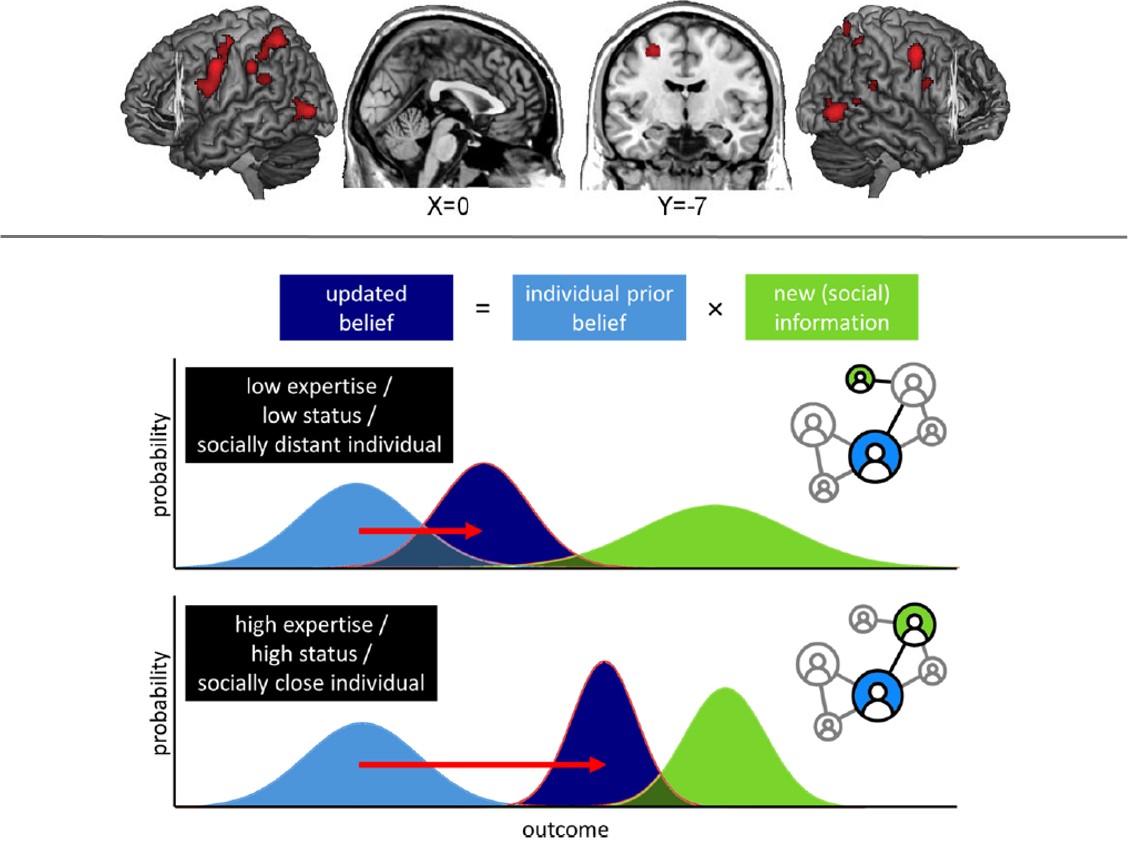
Bottom figure: from Hofmans and van den Bos (2022) in Developmental Cognitive Neuroscience: Bayesian updating of beliefs as a function of the social characteristics of the source. Social information is weighted according to its perceived reliability (expertise, status, proximity): it has a weaker impact when it comes from a low-credibility source (top diagram) and a stronger impact when it comes from a reliable source (bottom diagram). This differential weighting leads to a greater or lesser revision of the initial belief.
Learning under group pressure: conformity
Conformity is our tendency to align our judgments and behaviors with those of the group. Recently synthesized in a systematic review written by Emilie Caspar and myself (Tricoche and Caspar, currently under publication, preprint available), this body of work (going back to the first evidence provided by S. Asch in the 1950s) shows that we can go so far as to contradict our own sensory perception, beliefs, and memory in order to conform to the majority.
Two main levels of influence can be distinguished to explain conformity:
• Normative influence: we conform in order to be accepted, avoid rejection, and belong to the group,
• Informational influence: we conform because we consider others to be a reliable source of information, especially in situations of uncertainty.
These two levels of influence have direct implications for learning. If a child or an adult learns in a social environment (which is the case in the majority of school and professional situations), their responses will inevitably be influenced by what they perceive of others’ beliefs and knowledge. This can promote a rapid diffusion of knowledge (in the case of benevolent informational influence), or, on the contrary, suppress autonomous exploration if normative pressure is too strong, or even coercive—thereby undermining precisely the autonomy that SDT identifies as essential to intrinsic motivation.
The forms of social influence and social context described so far assume an interaction, or at the very least information coming from others. But what happens when no explicit information is transmitted, when the other person is simply there?
Learning through the mere presence of others
One thing is certain: others are always there. We learn surrounded by our peers, our teachers, our colleagues—rarely alone in front of a task and sheltered from any gaze. This is why it is important to ask whether this presence, even silent, even passive, would be enough to modify our behaviors and our (curiosity-driven) learning.
The first proof-of-concept evidence regarding the mere presence phenomenon goes back to the earliest observations and experiments by Triplett in 1898, who used a device—with a somewhat archaic appearance—to show that children performed better in a motor task when they were in pairs than when they were alone. Subsequently, many studies validated this positive effect of the presence of others, but also showed that it could impair performance. Researchers such as Zajonc (1965) and Baron (1968) proposed theoretical frameworks to explain this duality, which can be summarized—somewhat simplistically—as follows: the mere presence of others acts as an attentional distractor, improving performance on well-mastered tasks, but potentially disrupting success on new or complex tasks.
Three forms of social presence are typically distinguished:
• Passive audience: someone is there, present, but does not necessarily observe,
• Evaluation: someone is observing with a potentially evaluative gaze,
• Coaction: several individuals perform the same task at the same time, without direct interaction—thus distinguishing it from cooperation or competition, which involve interdependence between individuals and introduce a different level of social pressure.
For more exhaustive content on the mere presence effect
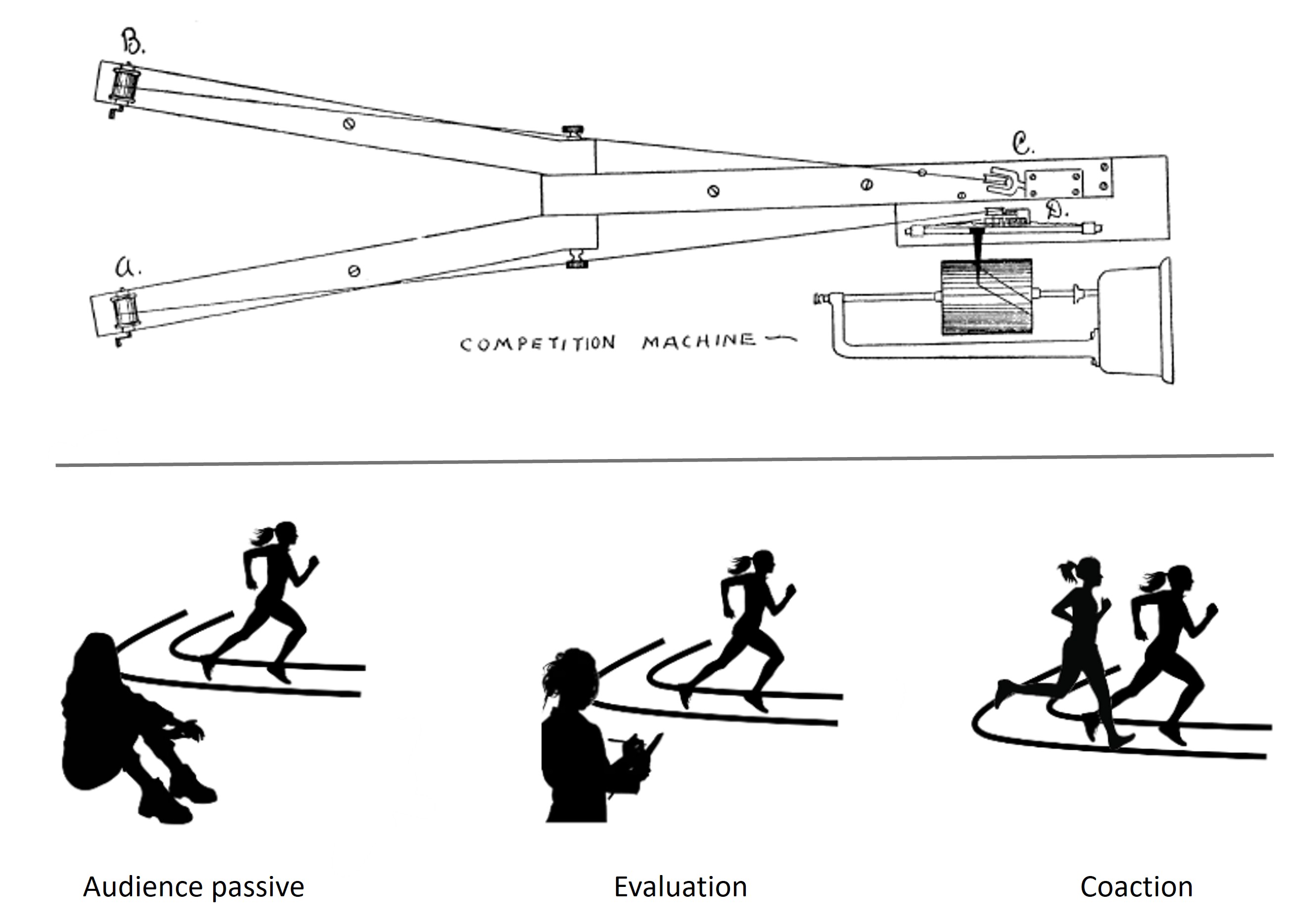
Bottom figure: the three types of mere presence represented in an example of a racing situation. One can distinguish passive audience, evaluation, and coaction.
This basic form of social influence seems to act on every type of behavior, from the most elementary (e.g., eating, moving the eyes) to the most complex (e.g., memorizing, deciding, counting) (Guérin, 2010). What about our learning and the associated intrinsic motivation, particularly in educational contexts?
I carried out a survey of the PubMed database, crossing terms related to mere presence on the one hand, and intrinsic motivation and learning on the other (studies in typically developing humans, considering original studies from the last 20 years, as well as reviews and meta-analyses from the last 10 years), and arrived at a rather surprising conclusion: the field is almost empty.
A few studies related to educational skills, in children and adolescents, show effects of social presence, notably on reasoning (Wolf et al., 2015), creativity (Camarda et al., 2021), or numerical and language skills (Tricoche et al., 2021). In addition, neuroimaging studies seem to indicate that the presence of another person does not act only on attentional processes, but also on motivational and emotional processes, even in the absence of any explicit reward (Tricoche et al., 2023). In other words, others, through their mere presence, could be a form of implicit extrinsic motivation, capable of influencing intrinsic motivation, without individuals necessarily being aware of it. Likewise, brain regions involved in social cognition are activated when others are present, in order to enable the mentalizing process. Indeed, as soon as another human being enters our environment, our mentalizing processes are activated—this capacity to infer the mental states of others, commonly referred to as theory of mind. “They can see me,” “what do they think of my performance?”, “do they like me?”: these questions, even when formulated unconsciously, mobilize cognitive and emotional resources that modify our engagement in the task. Others then become associated with a form of implicit social reward—being well perceived, approved of, accepted.
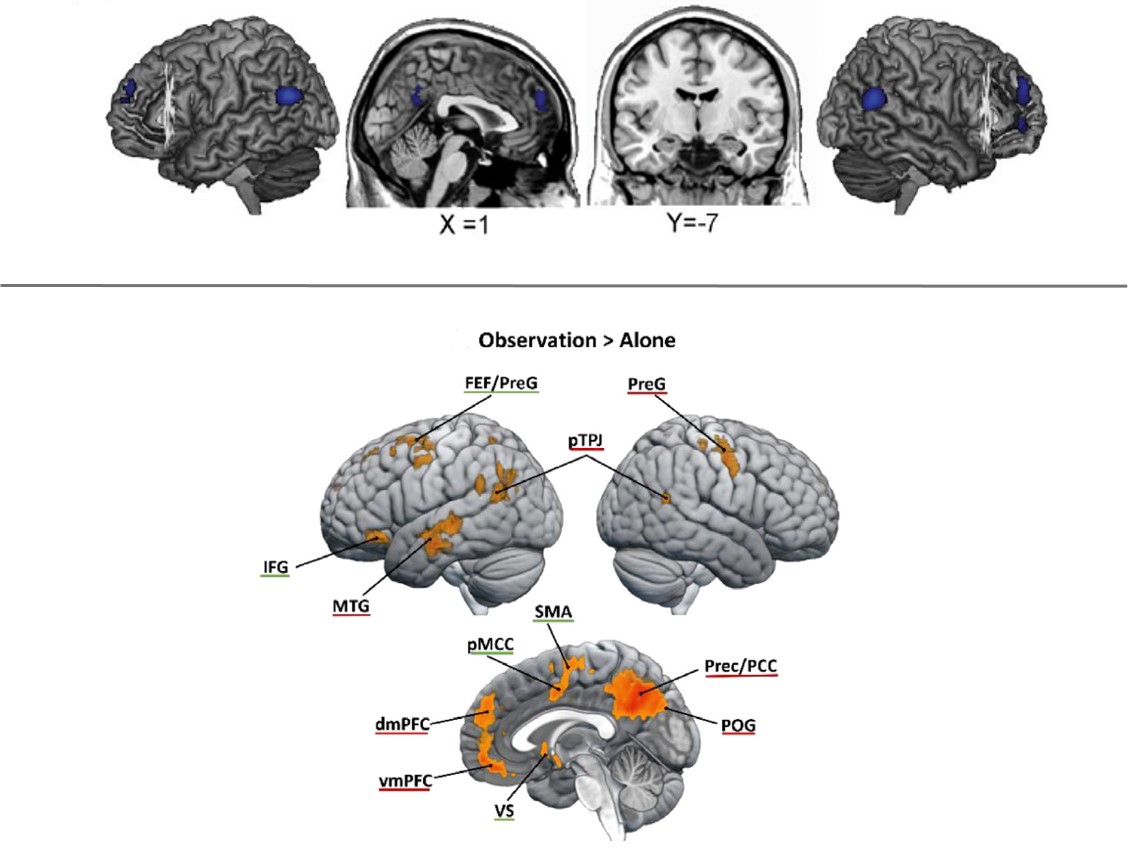
Bottom figure: from Tricoche et al. (2023) in NeuroImage: numerous regions are more activated in social presence than in the alone condition during the completion of cognitive tasks. These regions seem to belong to the attentional network, the mentalizing network, and the motivational network (the ventral striatum, VS, in particular).
The Flowers team in this landscape: the first milestones
It is precisely on this still little explored link between learning, motivation, and social presence that the Flowers team is beginning to raise empirical questions.
The team is known for its work on the computational mechanisms of curiosity and intrinsic motivation, notably in educational settings, some of which have been tested in schools. Paradigms have been developed specifically to address the understanding of factors related to curiosity, with a specific focus on the learning progress hypothesis (i.e., an intrinsic signal that guides exploration toward the activities that are the most informative and those that make us progress the most). Among them are so-called “free exploration” (gamified) tasks in which participants discover and freely explore an environment rich in learning activities with varying levels of difficulty (Ten et al., 2021; Poli et al., 2025; Serko, Leonard & Ruggeri, 2025). In these paradigms, participants can choose to continue the same activity or switch to another level of difficulty (simpler or more complex).
However, up to now, this work has mainly focused on the individual dynamics of curiosity. The explicit integration of social factors therefore constitutes a natural extension of this research program.
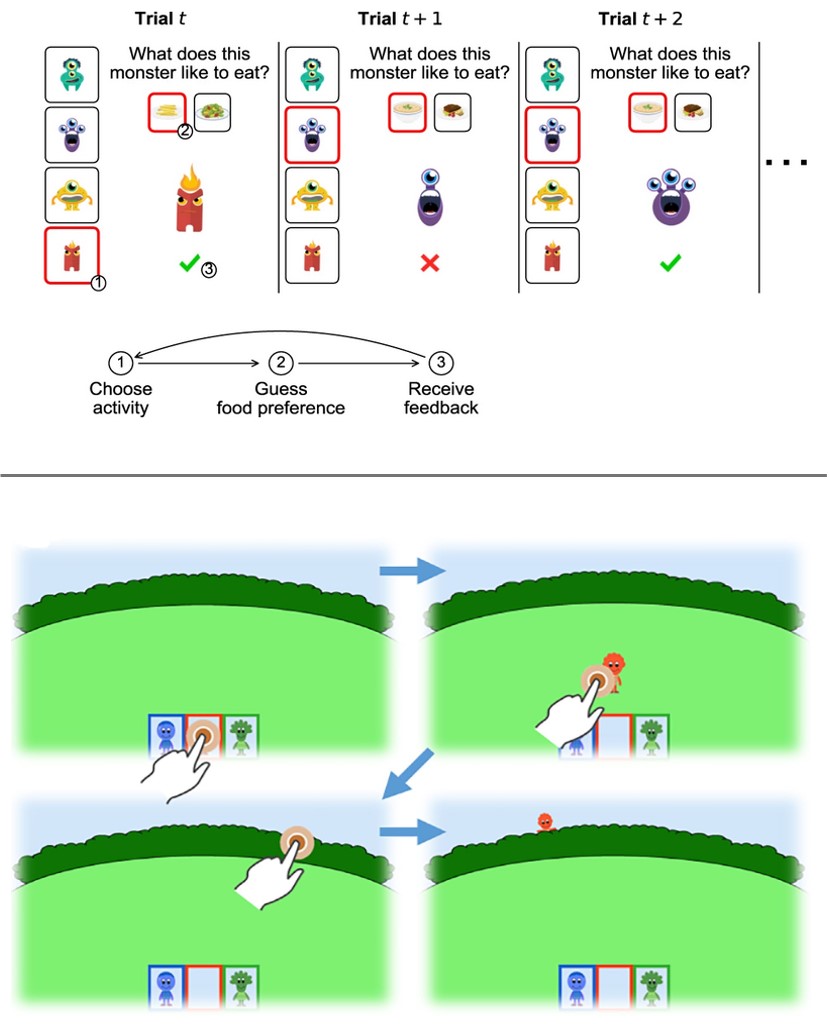
Top figure: from Ten et al. (2021) in Nature Communications: “Monster Task,” in which there are different families of monsters with hidden rules/behaviors that the participant freely discovers. At each trial, the participant chooses a monster, formulates a hypothesis about its food preference, then receives feedback.
Bottom figure: from Poli et al. (2025) in Child Development: in this exploration task, the participant interacts with characters by guessing the place where they are hiding.
A first step toward understanding social influence on curiosity-driven learning was taken through a study conducted by C. Devaux et al. (currently under publication). The results suggest that during metacognitive intervention sessions aimed at improving curiosity in learning, the type of adult leading the session had a different impact. Indeed, the presence of the regular teacher, compared with that of the experimenter, during these sessions, reduced pupils’ learning performance and curiosity. In addition, subjective questionnaires revealed an increased cognitive load. Possibly, pre-existing social dynamics—implicit expectations, hierarchical relationship, interactional habits—may influence the way pupils mobilize their cognitive and motivational resources. One interpretative hypothesis is that the social novelty embodied by the experimenter could act as an implicit motivational signal.
These first field findings open the way to a series of questions that I wish to address in the context of my postdoctoral work within the Flowers team, notably in collaboration with J. Perez (PhD student within the team; Perez et al., currently under publication, preprint available): is the mere presence of another individual enough for curiosity to intensify or deteriorate? Does the presence of a peer (classmate) have the same effect as that of an adult (teacher)? And how do these influences differentially affect learning according to age, educational context (e.g., traditional school versus Montessori pedagogy), or the child’s profile, whether in terms of cultural background, personality traits, or relationship with their social surroundings?
Conclusion
Thus, learning is not a solitary process. Others are not mere distractors or sources of pressure: they are also catalysts, mirrors, and silent partners of our curiosity. Understanding how and under which conditions they enhance—rather than suppress—our intrinsic motivation is a major scientific challenge, and a concrete educational challenge for all those who design learning environments and intervene in them.
References
• Arioli, M., & Canessa, N. (2019). Neural processing of social interaction: Coordinate-based meta-analytic evidence from human neuroimaging studies. Human Brain Mapping, 40(13), 3712–3737. https://doi.org/10.1002/hbm.24627
• Asch, S. E. (1951). Effects of group pressure upon the modification and distortion of judgments. Groups, leadership and men; research in human relations, pp. 177–190. Carnegie Press. https://doi.org/10.1525/9780520313514-017
• Bandura, A. (1977). Social Learning Theory. Prentice Hall.
• Camarda, A., Bouhours, L., Osmont, A., Le Masson, P., Weil, B., Borst, G., & Cassotti, M. (2021). Opposite Effect of Social Evaluation on Creative Idea Generation in Early and Middle Adolescents. Creativity Research Journal, 33(4), 399–410. https://doi.org/10.1080/10400419.2021.1902174
• Deci, E. L. (1975). Intrinsic motivation. New York, Plenum Press. https://doi.org/10.1007/978-1-4613-4446-9
• Deci, E. L., & Ryan, R. M. (1985). Intrinsic motivation and self-determination in human behavior. Springer NY. https://doi.org/10.1007/978-1-4899-2271-7
• Deci, E. L., Koestner, R., & Ryan, R. M. (2001). Extrinsic Rewards and Intrinsic Motivation in Education: Reconsidered Once Again. Review of Educational Research, 71(1), 1-27. https://doi.org/10.3102/00346543071001001
• Devaux, C., Abdelghani, R., Sauzéon, H., & Oudeyer, P-Y. (Under review). Metacognitive training of children’s curiosity in schools: investigating a teacher-led intervention.
• Guerin, B. (2010). Social facilitation. Cambridge University Press. https://doi.org/10.1017/CBO9780511628214
• Perez, J., Derex, M., Oudeyer, P-Y., & Moulin-Frier, C. Intrinsic motivation is key to understanding peer cultures. preprint
• Poli, F., Meyer, M., Mars, R. B., & Hunnius, S. (2025). Exploration in 4-year-old children is guided by learning progress and novelty. Child Development, 96:192-202. https://doi.org/10.1111/cdev.14158
• Rizzolatti, G., & Craighero, L. (2004). The mirror-neuron system. Annual Review Neuroscience, 27:169-192. https://doi.org/10.1146/annurev.neuro.27.070203.144230
• Serko, D., Leonard, J., & Ruggeri, A. (2025). Children strategically decide what to practice. Child Development, 96:1619-1631. https://doi.org/10.1111/cdev.14268
• Ten, A., Kaushik, P., Oudeyer, PY., Gottlieb, J. (2021). Humans monitor learning progress in curiosity-driven exploration. Nature Communications, 12, 5972. https://doi.org/10.1038/s41467-021-26196-w
• Tricoche, L., Monfardini, E., Reynaud, A. J., Epinat-Duclos, J., Pélisson, D., Prado, J., & Meunier, M. (2021). Peer presence effect on numerosity and phonological comparisons in 4th graders: When working with a schoolmate makes children more adult-like. Biology, 10(902), 643–662. https://doi.org/10.3390/biology10090902
• Tricoche, L., Pélisson, D., Longo, L., Kound, E., Poisson, A., Prado, J. & Meunier, M. (2023). Task-independent neural bases of peer presence effect on cognition in children and adults. NeuroImage, 277. https://doi.org/10.1016j.neuroimage.2023.120247
• Tricoche, L., & Caspar, E. (Under review). The power of social influence on (non-)moral decision-making and its resistance: A scoping review of behavioral effects and neural mechanisms. preprint
• Triplett, N. (1898). The dynamogenic factors in pacemaking and competition. The American Journal of Psychology, 9(4), 507–533. https://doi.org/10.2307/1412188
• Wolf, L. K., Bazargani, N., Kilford, E. J., Dumontheil, I., Blakemore, S-J. (2015). The audience effect in adolescence depends on who’s looking over your shoulder. Journal of Adolescence, 43: 5-14. http://dx.doi.org/10.1016/j.adolescence.2015.05.003
• Zajonc, R. (1965). Social facilitation. Science, 149, 269–274. https://doi.org/10.1126/science.149.3681.269